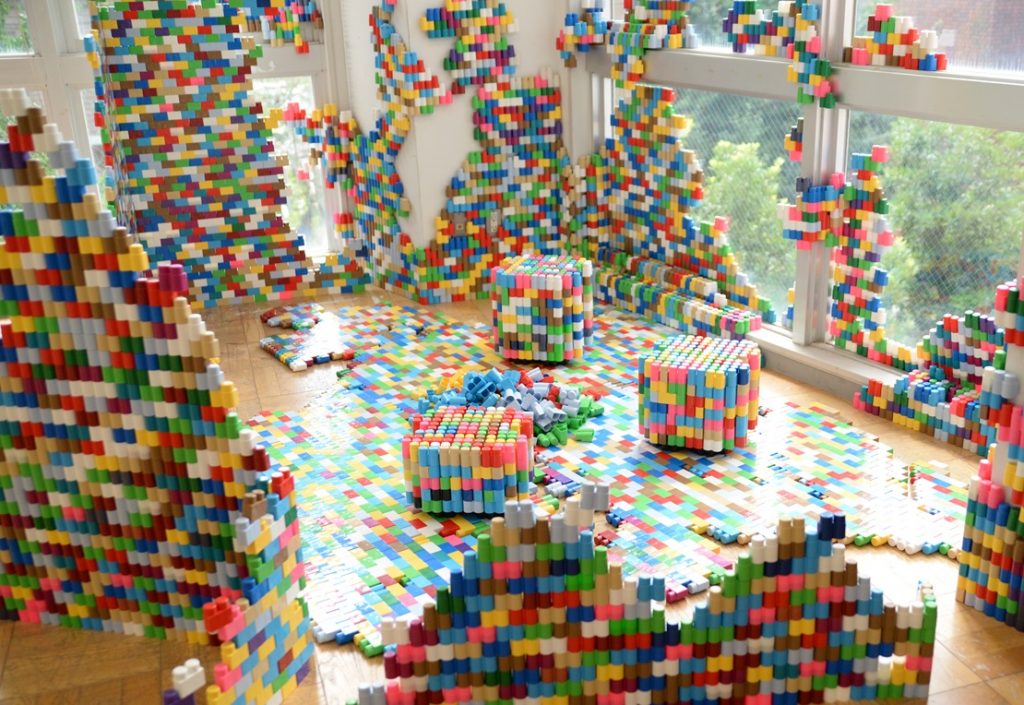
Since April 2019, the Department of Design at Tokyo University of the Arts and JAKUETS has launched a joint design research project to explore the possibilities of play and play equipment/teaching aids. The first subject was “B BLOCK," a product with over 50 years of history at JAKUETS.
B BLOCK: One Simple Shape
The B BLOCK is a very simple block developed in 1966. It has a B-shaped base with two studs. Its size is slightly larger —measuring 4.5cm in height, 5.1cm in width, 2.5cm in depth— designed to prevent young children from accidentally swallowing it and to make it easy to hold in small hands. While there are blocks on the market that offer a wide variety of parts, B BLOCK, by contrast, consists of only this single basic piece, with the only additional part being a wheeled piece, maintaining a consistently simple design.
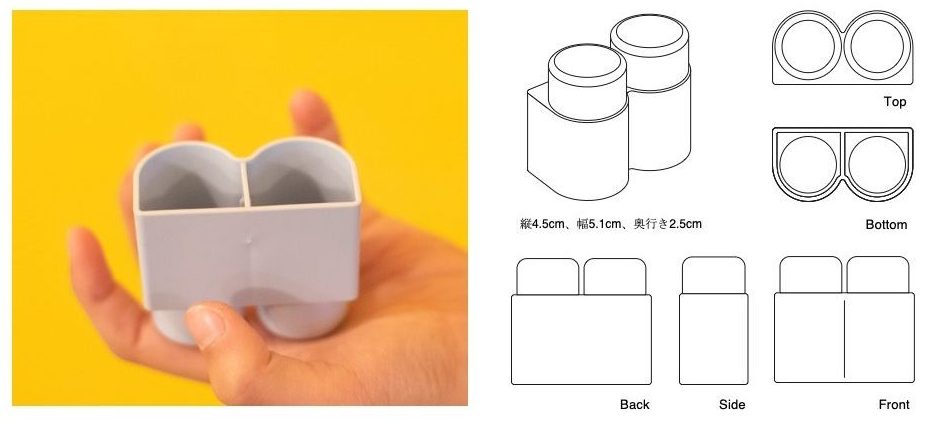
Photo: Akari Taniguchi
Drawings: Ryota Igarashi
Why the " B " shape?
According to Seiji Kihara, the original developer, he initially considered using the figure “8.” However, in pursuit of ease in attaching and detaching pieces for small children—that is, how easily air could escape—he arrived at the letter "B", which is composed of both straight and curved lines.
He adopted ABS resin, which was still high-grade at the time, due to its balance of strength and flexibility. The current material is an even softer resin called Elastomer Septon, which absorbs distortion during assembly. Thanks to its flexibility, the blocks do not break easily even when built with curved lines, making it possible to create smooth, rounded shapes.
With its highly functional and streamlined design, B BLOCK has been loved and widely used in childcare settings across Japan for over half a century. It can truly be said to embody the ideal form of play equipment/teaching aids.
We intentionally chose B BLOCK—already a well-established and familiar product in society—as the theme of our joint research. By re-examining it through a creative design perspective, we aimed to explore unknown potential and “draw out” the new possibilities for play that might emerge from it. In the process, we sought to free ourselves from conventional ideas of "blocks" and "block play”, and return to a more fundamental question: "What is play?".
Following this guiding approach, eight students—from second-year undergraduates to first-year master's students—carried the project forward under the supervision of Associate Professor Yoshiyuki Yamazaki of the Department of Design Studio 7 (Design Experience).
Research that began in the Tokyo University of the Arts studio
In design research within the Department of Design, the approach often begins not with the intellect, but with the body. In other words, before engaging with secondary information such as documents or explanations, students first confront the subject physically and experience it through their five senses.
In this project as well, during a studio session in June, the students encountered 200 B BLOCK pieces with no prior information. Although the group included students from different year levels—many meeting for the first time—once they naturally began to pick up the blocks piled before them, their facial tension gradually dissolved, and soon the room was filled with voices and laughter.
Through this scene, we could see the unique characteristics of B BLOCK as a play and teaching tool—its low barrier to entry, its power to connect people, and its ability to lighten the mood.
Meanwhile, the students continued to explore B BLOCK in their own ways: gazing at it, building it up, breaking it apart, tapping it to hear its sound, blowing air into its hollows, and holding it to the light to observe its color. Some even began to bite it, took off their shoes and stepped on it with their socked feet, wrapped arched chains of blocks around their neck and danced, built small mountains and crawled under them. Their free-spirited interactions with the blocks escalated in delightful and unexpected ways over the course of an hour.
After this series of embodied encounters, an entirely new and unseen landscape of play began to emerge from B BLOCK. The many flashes of inspiration and sketches were refined over the following month through three presentations and discussions.
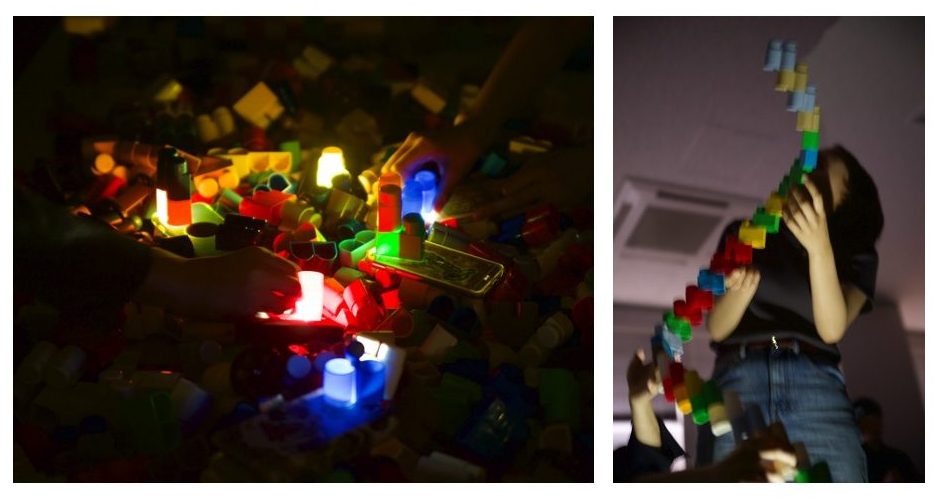 A moment in the atelier where children encountered B BLOCK.
Photo: Yusuke Aonuma
Where Block play Takes Off
The students’ free-flowing ideas and sketches were further refined and developed through three rounds of presentations and discussions over the course of approximately one month. The following are some examples from that process.
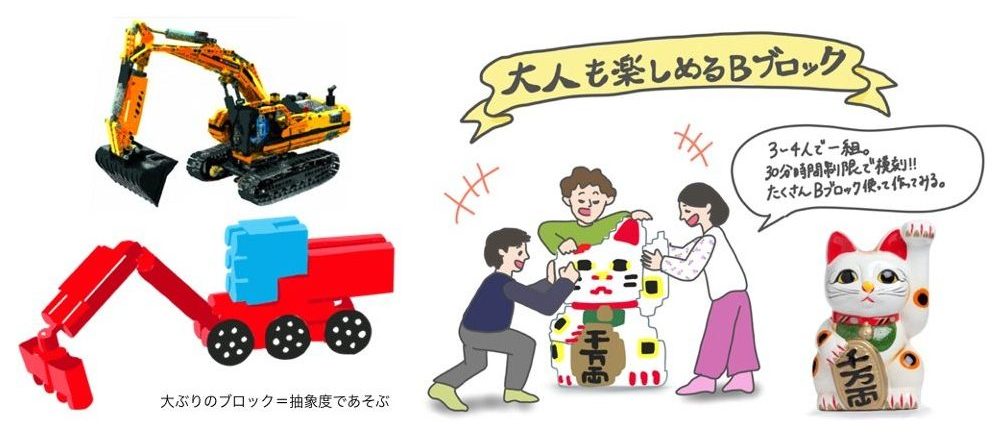
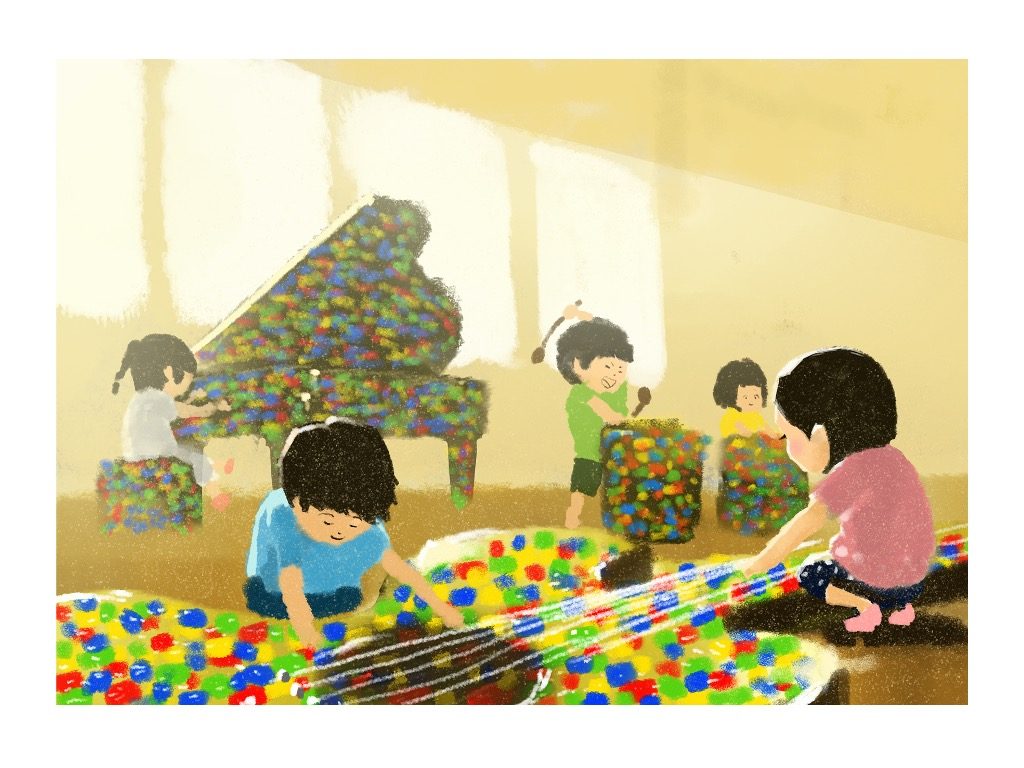
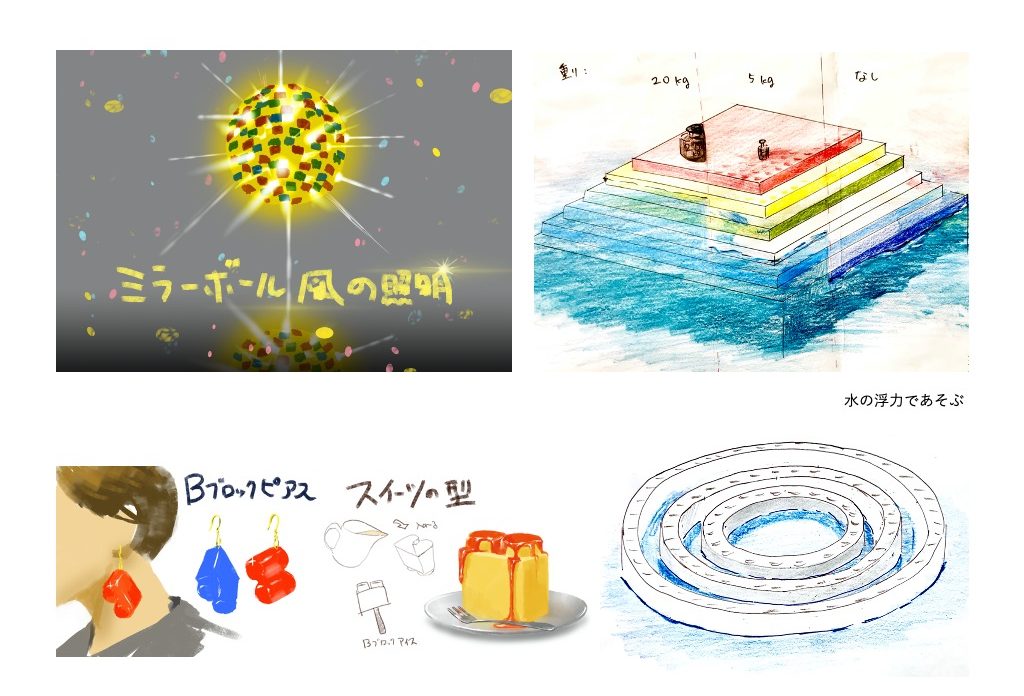
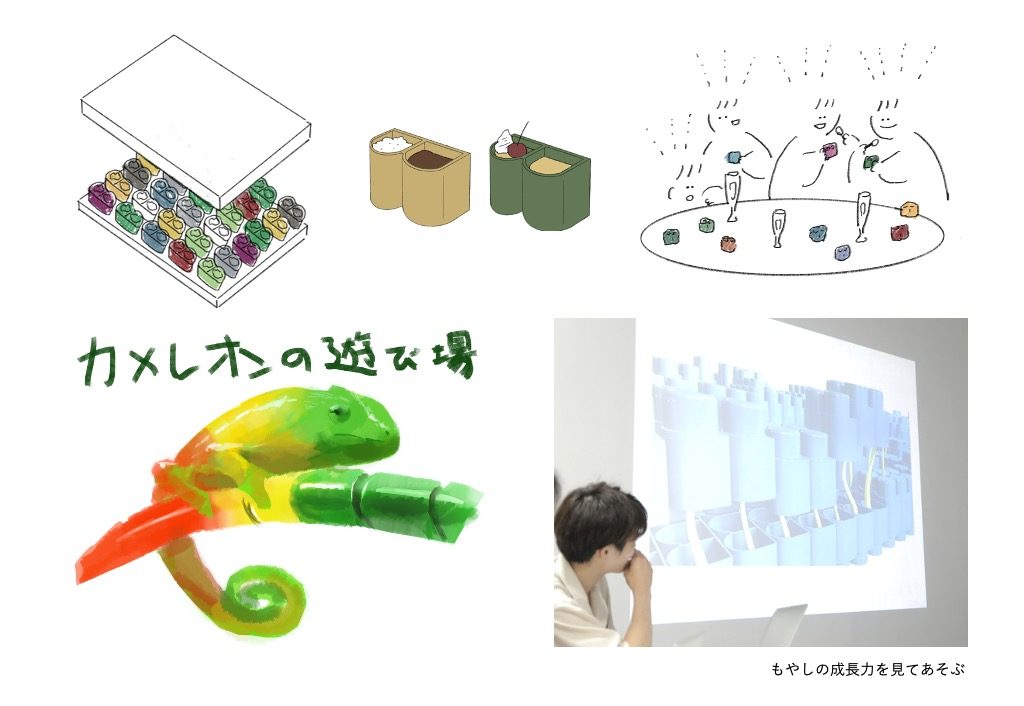
The block play depicted in these sketches differs from the typical tabletop block play. One sketch shows blocks being used to decorate and shape living spaces, while another portrays them as tools for interacting with plants, animals, and other elements of nature.
This raises a key question: Can resin-made B BLOCK truly adapt to such free-flowing ideas? However, it appears that the students continued to run small experiments alongside their sketching, testing these possibilities in their own time.
For example, they explored the degree and limits of curvature when creating curved surfaces; methods for stabilizing linear structures; changes in color and brightness when artificial or natural light passes through; how the blocks float or sink in water; safety for use as food containers; heat resistance; cutting techniques; the growth force of bean sprouts pushing up the blocks; and the conditions of root rot when hydroponically growing plants in concave areas.
All of these small, analog experiments accumulated in their bodies as lived experience.
Meter-Scale Experiments
In August, responding to students’ request to put their ideas into full-scale production, JAKUETS provided an enormous supply of approximately 75,000 B BLOCK pieces. The sketches for production were refined into seven directions, each derived from the characteristics of B BLOCK observed through experimentation. The following pages present the results— seven projects developed as case studies.
Case 1: B BLOCK × Fashion Wearable Blocks
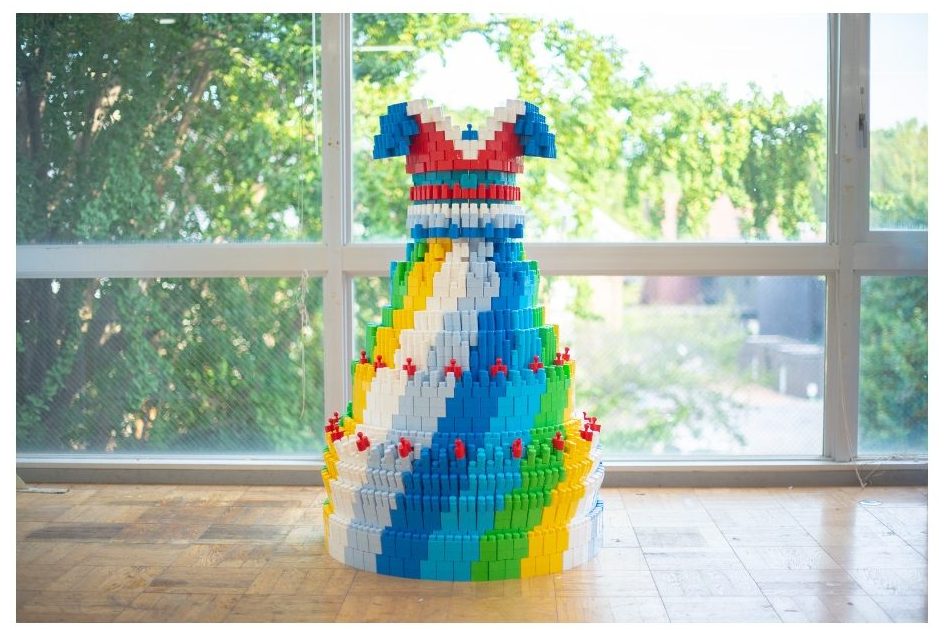
Inspired by the curved forms that can be created with B BLOCK, the idea of making clothing emerged. By developing this concept further, it may be possible to create blocks that allow anyone to play as a fashion designer.
Design: Yumeno Katsukawa
Photo: Yusuke Aonuma
Case 2: B BLOCK × Food Blocks for Serving Food
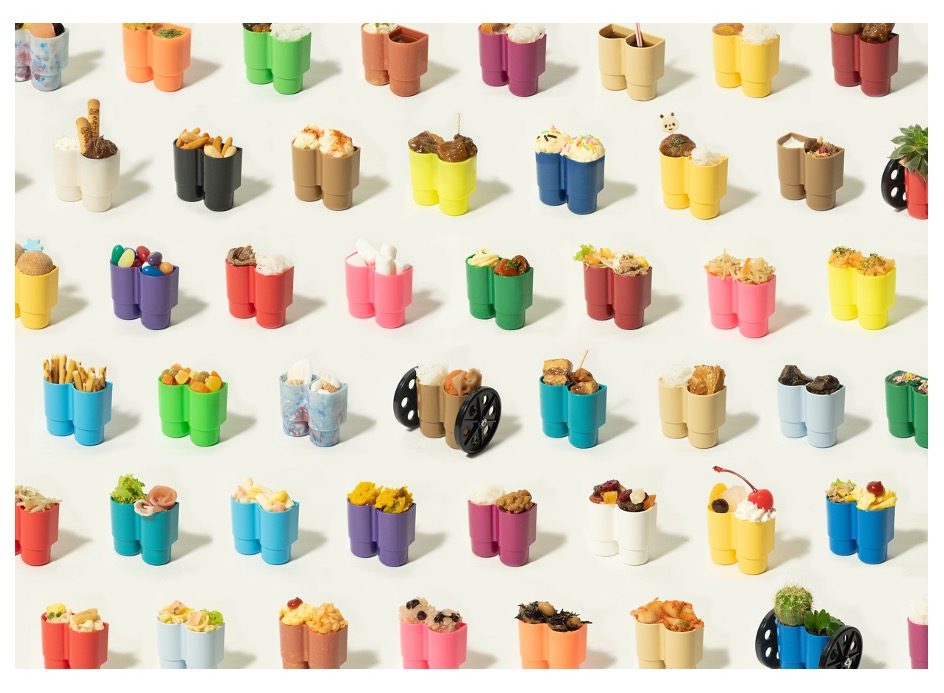
Focusing on the structural underside of the blocks—normally hidden from view—and making use of their palm-sized scale, the idea emerged to transform them into tableware. Coordinating the colors of the blocks with the colors of food adds to the enjoyment, and by connecting the pieces, they could also be developed into small storage containers.
Design: Akari Taniguchi
Case 3: B BLOCK × Music Musical Blocks
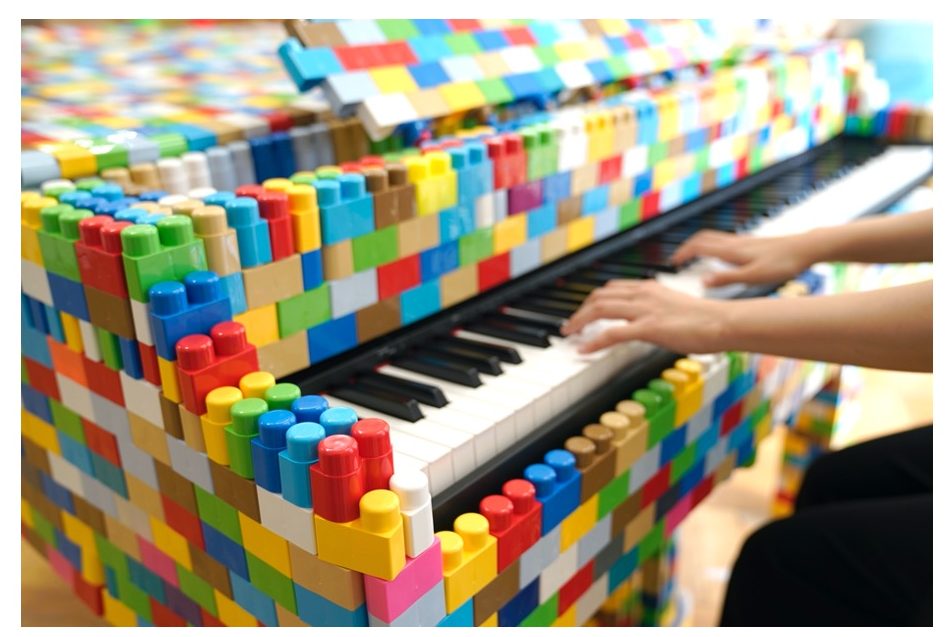 Pianos are typically black, but making them colorful creates a different atmosphere in which music can be enjoyed. Perhaps even things that seem intimidating or overly rigid could, when made from blocks, contribute to a more peaceful world.
Design: Arinori Teramoto
Photo: Daisuke Oki
Case 4: B BLOCK × Quiz Blocks for Finding Answers
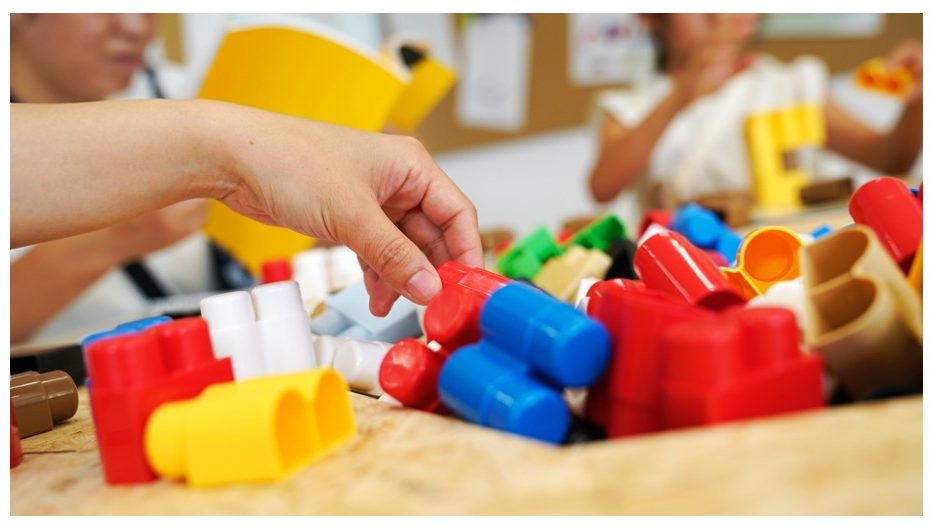
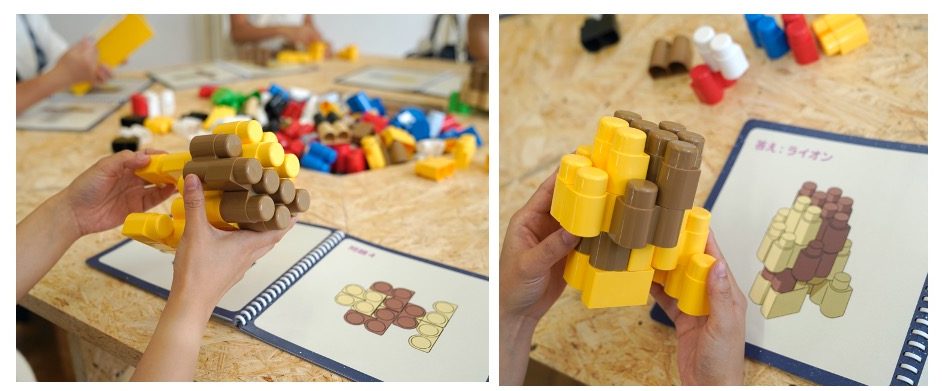 A quiz in which participants recreate an object—drawn from a top-down view—using blocks to discover the answer. The curves and straight lines of the “B” serve as key clues. While blocks are typically meant for free and open-ended play, this quiz introduces an inverted approach by adding constraints to the experience.
Design: Ryota Igarashi
Photo: Daisuke Oki
Case 5: B BLOCK × Space Invasive Blocks
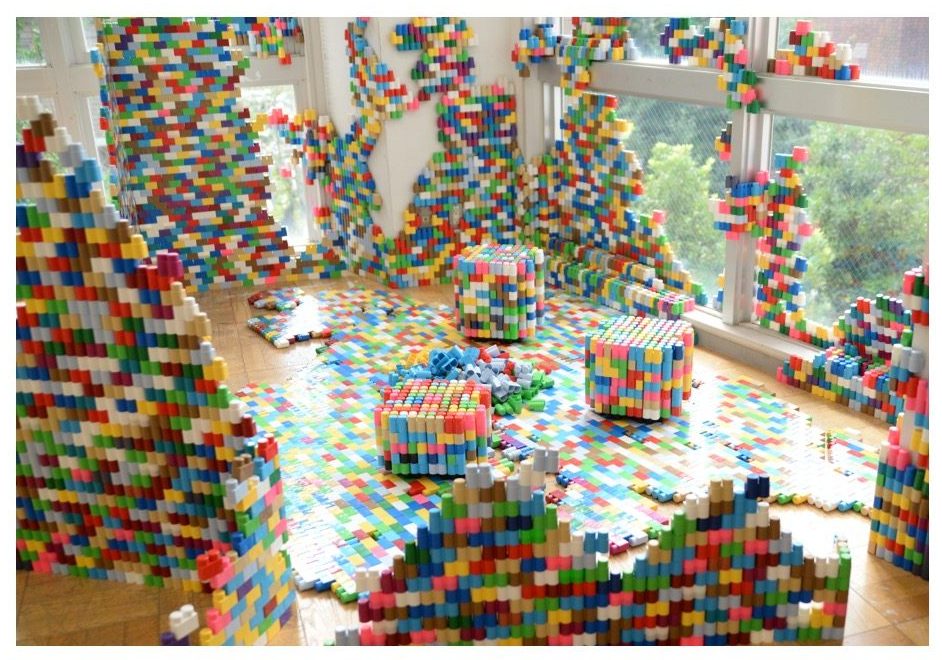 Blocks that encroach into living spaces, creating environments for relaxation and play. Surrounded by blocks, people can unwind, play, and enjoy rearranging the space with ease. Because B BLOCK is hollow inside and features curved surfaces, it feels soft underfoot and also provides thermal insulation.
Design: Azusa Morita + Yuko Yamane
Photo: Yusuke Aonuma
Case 6: B BLOCK × Light Illuminated Blocks
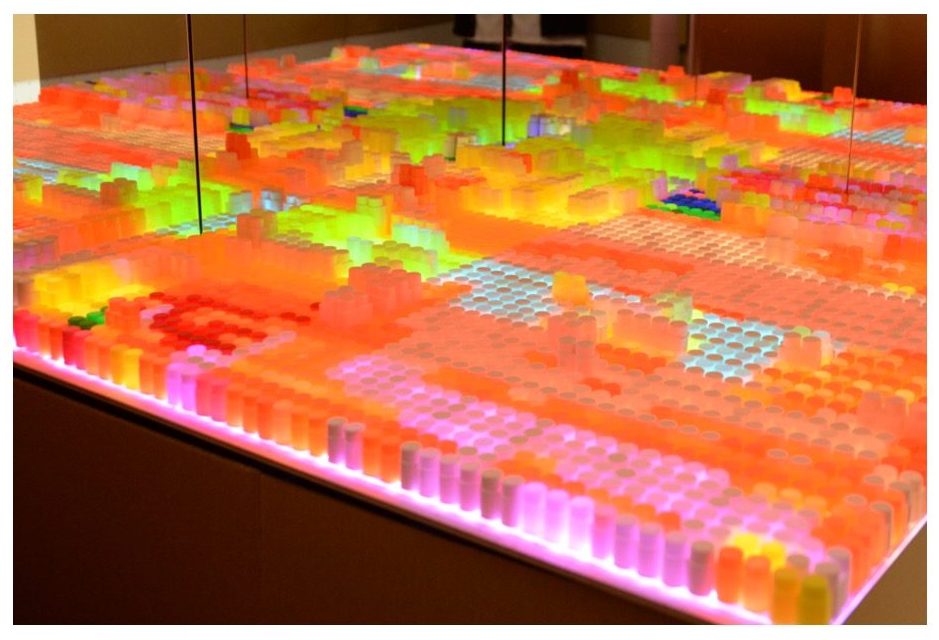 The light source beneath the structure is programmed to gently pulse over time. As the light interacts with the B BLOCKs, each color reveals subtle shifts in tone, creating a unique visual effect.
Design: Reo Otake
Photo: Yusuke Aonuma
Case 7: B BLOCK × Water Playing with Water Blocks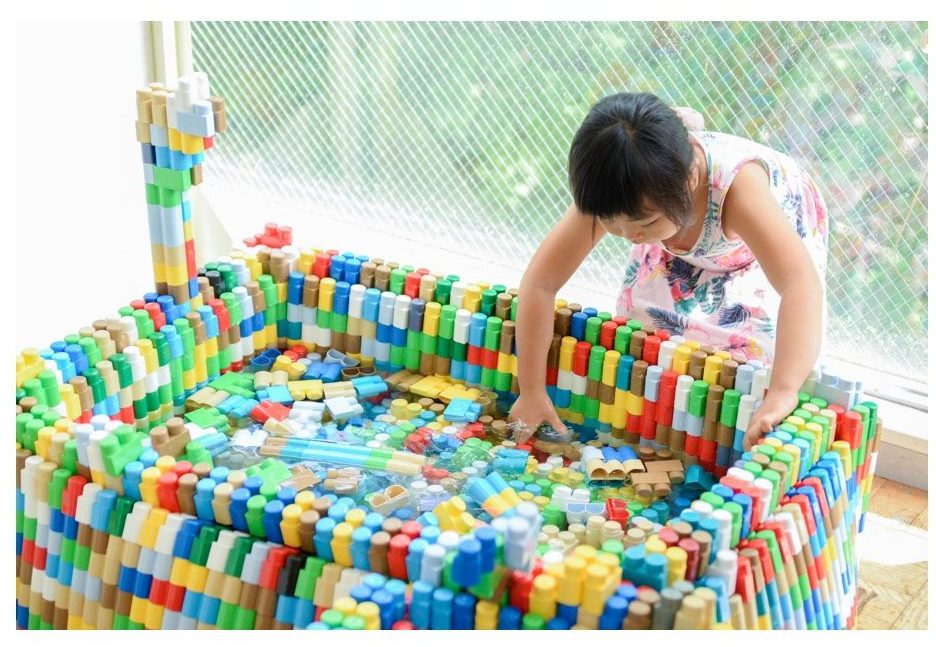 The subtle balance of B BLOCK’s density—allowing it to both float and sink—creates a sense of intrigue. By enjoying the buoyancy of the blocks in water, their unfamiliar appearance beneath the surface, and the sounds they make as they collide, participants are invited to explore free-form creation using water.
Design: Seina Yamaguchi
Photo: Yusuke Aonuma
The exhibit, planned by student volunteers, was held in a room at Geisai in September. Over the course of three days, more than 2,000 visitors came through the space, and the excitement exceeded expectations each day. At Geisai —where many artworks cannot be touched— it is rare to find a space where visitors can touch the pieces and actively take part in creating and playing with them. Some children and adults stayed for over an hour, playing the block piano, taking on block quizzes, taking photos in block-made dresses, splashing in water with blocks, and adding their hands to the block walls created by the students.
The venue also features a small gallery — about two tatami mats in size — where visitors could enjoy the shifting colors of the blocks created by computer — controlled lighting. A table set for block quizzes was also installed. The table is hexagonal, allowing two people to sit side by side on each edge, and includes a recessed center for storing blocks. These installations serve as notable proposals for new environments in which to experience blocks.
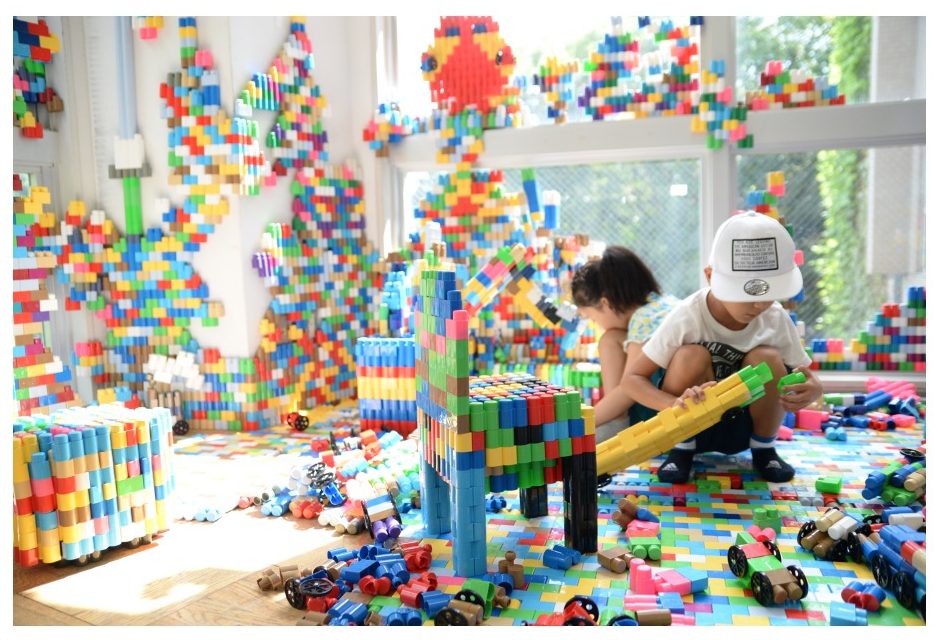
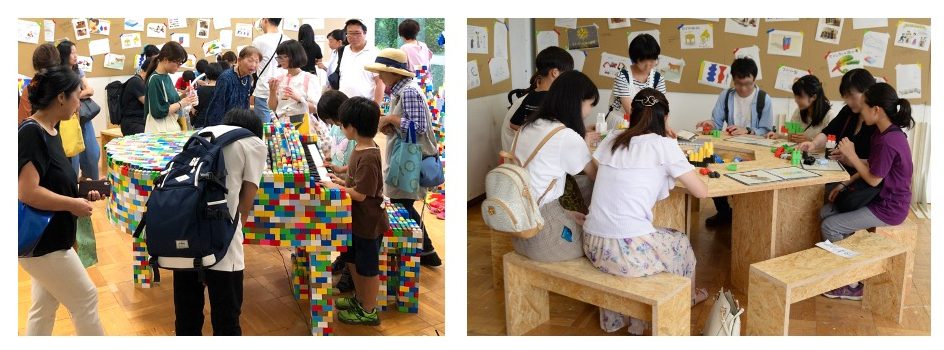 A moment from the exhibition—children and adults alike fully absorbed.
Photo: Yusuke Aonuma
The Future of Play as Seen Through B BLOCK
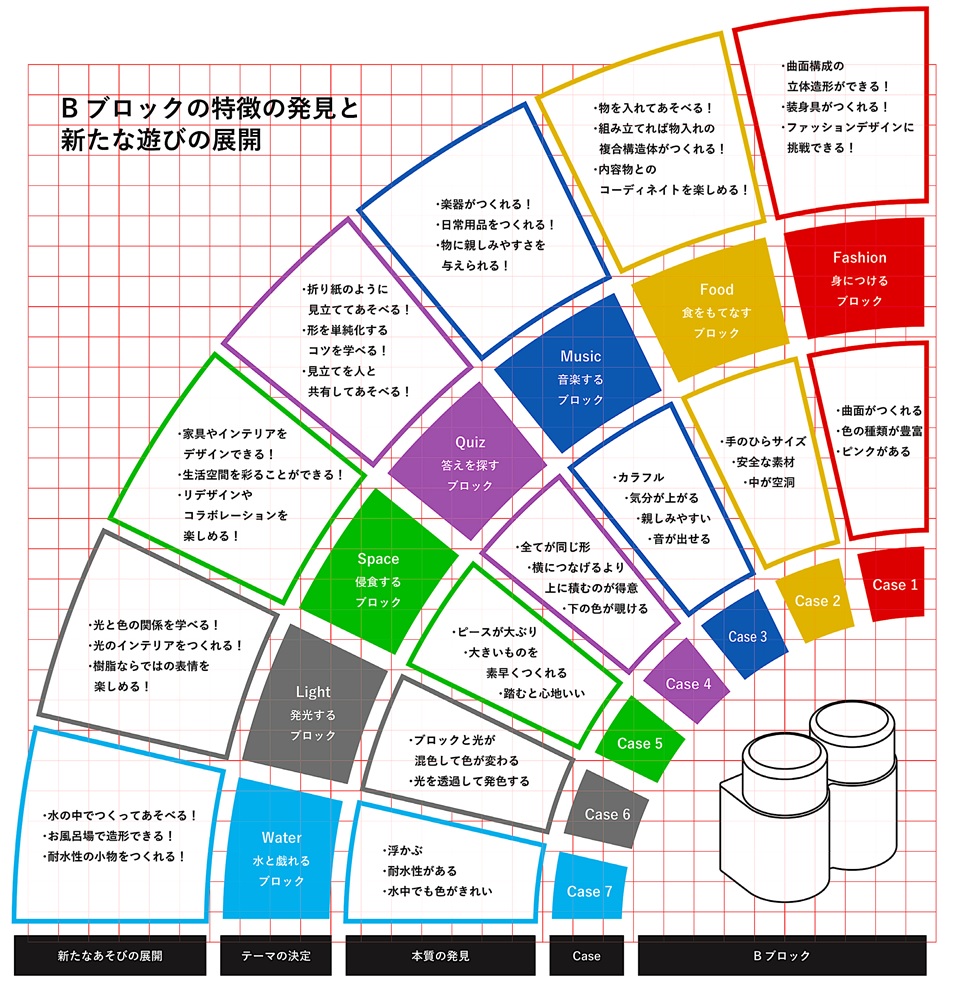
The process behind these seven case studies is summarized in the diagram below.
Starting from the lower right corner, the chart illustrated how the project unfolded: we first identified the characteristics of B BLOCK through experience, then established seven directions (cases), extracted themes, and finally developed works as concrete examples of potential forms of play. The outer arc of the diagram represents the new possibilities for play that may open up in the future.
 Drawings: Ryota Igarashi
If there is one highlight that emerged from this project, it would be that the size and properties of B BLOCK made it possible to create works at a human scale. Measuring roughly 5 × 2.5 cm in size, the blocks can be assembled quickly, and if the direction doesn’t feel right, they can easily be taken apart down to a single piece. With a sufficient number of blocks, it is possible to create an object at a household-scale within just a few hours. Furthermore, experiments creating chairs and carpets revealed their durability — showing that they can withstand being stepped on or sat on without breaking.
This speaks to the affinity between B BLOCK and everyday life, suggesting the possibility of block play not only among children, but also between adults and children, and even among adults alone. Humans are playful beings, and play has been a driving force in human evolution — as the Dutch historian Johan Huizinga argued. What possibilities unfold when B BLOCK becomes tools for people of all ages, and when they are bricolaged together with different materials, natural objects, and everyday technologies? Anyone can reach out and assemble them without hesitation, and if the result doesn’t feel right, they can be taken apart and rebuilt at any moment. And they do not deteriorate, no matter how many times they are "built" and "dismantled". In addition to these unique qualities, B BLOCK is easy to hold, fits smoothly together, and allows for the creation of objects at a bodily scale. With these features, it is expected to encourage the initial spark of creativity and support ongoing experimentation.
(Project Manager / Part-Time Lecturer, Department of Design, Tokyo University of the Arts — Harumi Kusumi)